
Cow pregnancy rates have increased substantially over the past 30 years, with award-winning herds achieving pregnancy rates as high as 47%. Surprisingly, heifer-pregnancy rates have not kept pace, and that’s where many dairies are still leaving money on the table.
The average cow-pregnancy rate for a subset of CentralStar herds that utilize consulting services is 28%, ranging from 18% to 43%. The heifer-pregnancy rate for 64 of those herds averages 29% and ranges from 10% to 50%. In other words, heifer-pregnancy rates average just 1% higher than cow-pregnancy rates, but with nearly double the variation. In that same data set, the average conception rate to conventional semen is 46% for cows and 61% for heifers. If heifers conceive 15% better than cows, why is their overall pregnancy rate barely higher? That gap is the opportunity.
Why 40% pregnancy rate matters
For most dairies, a realistic goal for heifer-pregnancy rate is 40%. Increasing heifer-pregnancy rates can reduce rearing costs, bring replacements into the herd sooner, and create more calves each year. In a case scenario, Figure 1 shows the distribution of age at first calving for a herd with a 40% heifer-pregnancy rate versus a 25% pregnancy rate. Both herds start breeding heifers at 390 days old, yet the herd with a 40% pregnancy rate averages 22 months at first calving, while the 25%-pregnancy-rate herd averages 24 months.

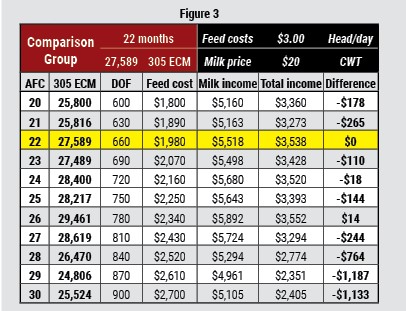
The heifers calving in at an older age may produce more Energy-Corrected Milk (Figure 2), but the extra production doesn’t outweigh the extra feed costs (Figure 3). Based on this production data and the age-at-first-calving profile for these 100 heifers, the herd with a 25% pregnancy rate has over $8,000 more in opportunity cost from later calvings than the herd with a 40%-pregnancy-rate. Furthermore, the 40%-pregnancy-rate herd has a lower non-completion rate, 10% compared to 14%, meaning more heifers successfully make it to the milking herd when pregnancy rates are higher.

Why do heifers lag?
Heifer-conception rates average 15% higher than cow-conception rates. Even the bottom 25% of herds for heifer conception average 5% higher than cows. The issue isn’t usually conception, it’s getting heifers inseminated in the first place.
Whether a herd breeds heifers by age or weight, 90% of heifers should be bred for the first time within a 30-day window. Low-insemination rates often stem from three things.
- Difficulty moving heifers into the breeding pen on time. Some farms struggle with labor or overcrowded facilities. Working with a CentralStar consultant to develop a breeding strategy can help right-size heifer inventory and reduce overcrowding. Consultants can factor in a buffer, so the farm is never short on replacements, while also capturing added value through beef on dairy calves. Genomic testing can also identify which animals should produce replacements, ensuring only the best heifers move into the breeding program.
- Lack of a consistent heat-detection program. A lack of routine heat detection hinders insemination rates. A good goal is for more than 60% of heifers to be rebred within the normal heat-cycle window of 18–24 days. Utilizing a CentralStar A.I. Specialist and/or a monitoring system like CowManager® can improve both conception and insemination rates. Because sexed semen works best when used 16–24 hours after estrus begins, CowManager’s insemination window can help maximize success.
- Heifers being too small for breeding. Heifers should reach 55% of mature body weight before their first breeding. Many undersized heifers have a history of calfhood diseases like pneumonia or scours. These health setbacks delay breeding and limit their future milk potential. Prevention is key. Selecting for calf-wellness traits, feeding high-quality colostrum or replacer followed by a high-quality diet, following a veterinarian-approved vaccination program, and supporting the immune system with products like AccelAIRate or CONVERT™ all help heifers stay on track. CowManager’s new Youngstock Monitor can even detect illness in calves before clinical signs appear.
The payoff
Heifer reproduction is still one of the biggest opportunities in many dairies. Heifers are typically the highest-genetic animals in the herd and carry the most-valuable pregnancies. With today’s low heifer inventories and the cost of raising replacements, it’s more important than ever to complete as many heifers as possible and to make sure those heifers are of the highest quality. If you would like help with your heifer reproduction, reach out to your local CentralStar team.
Author: Emily Middleton-Gyomory, CentralStar Regional Consulting Manager