
A herd with a bulk tank somatic cell count (SCC) of 115,000 would be considered a milk quality success by most industry standards. Yet, a look at this 1,000-cow herd, shows cows with an average lactation somatic cell score (SCS) of 4.0 or greater produced 900 fewer pounds of energy-corrected milk (ECM) per cow compared to herdmates with lower SCS. While only 7% of the herd fell into this higher SCS category, the lost milk still added up to nearly $12,000 in unrealized production.
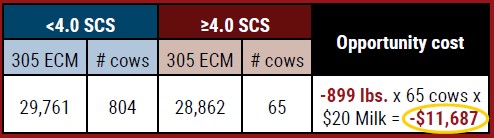
The impact of higher SCC went beyond milk production. These cows also averaged 15 more days open than cows with a lactation average SCS below 4.0. While only 7% of the herd is represented by SCS of 4.0 or higher, it all adds up and highlights how subclinical mastitis can decrease profitability even in herds with excellent bulk-tank SCC. There can be high SCC cows that are heavy shedders but can be diluted in the bulk tank, especially in larger herds.
This example clearly shows that even herds with low bulk tank SCC can incur hidden losses that quietly erode performance. The key is knowing where to look and using the right tools and metrics to uncover what the bulk tank alone can’t reveal.
Beyond the bulk tank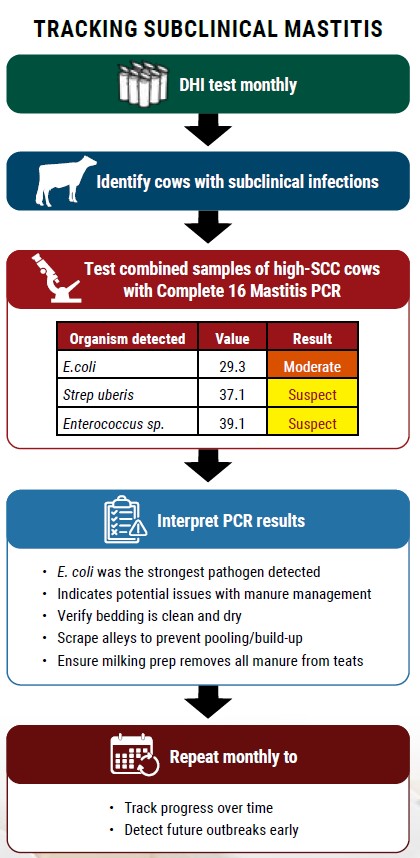
Frequently monitoring bulk-tank SCC is an important indicator of overall milk quality, but it does not tell the whole story. In a 2025 Hoard’s Dairyman webinar on milk quality¹, Michigan State University’s Pamela Ruegg, D.V.M., shared it’s not enough to only use bulk-tank SCC to monitor a herd’s milk quality; it is also important to monitor subclinical and clinical mastitis. Following are several valuable key performance indicators (KPI’s) Ruegg shared that are important for managing your herd.
- Percent of herd with subclinical mastitis (SCC >200,000): <15%
- New infection rate: <8% (SCC <200,000 on prior test and >200,000 on current test)
- Percent of cows with chronic infection: <8% (SCC >200,000 on prior and current test)\
- Fresh infection rate, 1st lactation: <10% (SCC >200,000 on first test)
- Fresh infection rate, 2nd+ lactation: <15% (last test previous lactation <200,000 and first test current lactation >200,000)
It’s impossible to calculate or manage these metrics without routine monthly DHI testing.
Do something with the data
Pathogen identification is an important next step which helps guide the course of action. For individual cows it leads to treatment or culling and can identify if adjustments need to be made with bedding-management practices, teat-dip products, etc., for groups or the whole herd. CentralStar has created a resource to help guide the next steps. Review this guide to learn more about effectively managing mastitis pathogens, from identifying the source to key prevention strategies.
The importance of pathogen identification is underscored in the 2025 Hoard’s Dairymen Round Table² featuring National Dairy Quality award winners. All six herds represented identified routinely DHI test to monitor subclinical mastitis and also perform pathogen identification testing to determine if and how a cow should be treated.
The role of genetics
Managing subclinical mastitis today is critical, but genetic selection can help reduce risk over the long term. The Herd Health Profit Dollars® (HHP$®) index places 13% emphasis on mastitis resistance for Holstein sires. The top 100 Holstein sires for HHP$ have an average SCC of 2.84 compared to the top 100 Holstein sires for NM$ which average 2.93. The same top 100 HHP$ bulls are also a full point higher for mastitis resistance.
Obviously, genetics alone won’t eliminate mastitis challenges, but incorporating mastitis resistance into selection can support ongoing management efforts and protect future production.
Hidden losses
While an average case of mastitis costs around $250³, subclinical mastitis is just as costly at $110⁴/cow/year because it often goes unnoticed. This herd example is proof that low bulk-tank SCC doesn’t tell the whole story.
Identifying these losses requires looking beyond the bulk tank, using monthly DHI testing, monitoring key mastitis KPIs, and following up with pathogen identification when needed. Connect with your CentralStar team to identify opportunities in your herd and put a plan in place to reduce these hidden losses.
Author: Emily Middleton-Gyomory, Regional Consulting Manager
References:
¹https://hoards.com/article-37346-put-that-data-to-work-manage-milk-quality.html
²https://www.nmconline.org/wp-content/uploads/2025/02/Making-the-most-oftheir-milk-RT.pdf
³https://www.agproud.com/articles/62526-dollars-down-the-drain-what-one-caseof-mastitis-can-cost you#:~:text=The%20average%20cost%20of%20a,make%20decisions%20regarding%20mastitis%20difficult.
⁴Ott SL 1999: Cost of herd level production losses associated with subclinical mastitis in U.S. dairy cows NMC annual Meeting proceedings 199:152