
One of the things I enjoy most about working with CowManager® is helping producers turn data into decisions that improve cow performance.
I began working with a 4,000-cow dairy that was already using CowManager but was not yet using the Transition Monitor feature of the system. I talked with the herd about activating this feature, because it can help identify transition cows with early, subclinical health issues before calving. By treating these cows sooner, it minimizes clinical sickness after calving.
This winter, we began using CowManager’s Transition Monitor to watch dry cows for changes in eating and rumination behavior. The system identifies underperforming cows compared to their pen mates.
The dairy was already locking up dry cows twice a week for routine vaccinations and movement to the close-up calving pen. Rather than creating additional work, we decided to build a treatment protocol for cows with transition alerts directly into their existing process.
The practice we agreed on included any cow that triggered a transition alert within the previous seven days was treated during those routine lockups. We excluded cows with obvious lameness issues and focused on supporting rumen health and encouraging feed intake before calving.
For the treatment, the farm team administered two Tri-Start Bolus. We chose this direct-fed microbial, because it supports rumen function and feed intake, giving cows extra support before calving and helping them maintain the intake needed for a successful start to their lactation.
What I liked most about this approach was its simplicity. There was no additional labor required at the farm and no disruption to cow comfort. The protocol was easy for employees to follow and helped maintain consistency over time.
Once implemented, we quickly saw results. Within the first month, postpartum-health events decreased compared to the months prior with no transition alerts being acted on. The first month’s trend was encouraging and reinforced what we often see with CowManager monitoring: When we identify at-risk cows sooner, farms have a better chance of preventing problems before they become costly health events.
Four months of acting on transition alerts pre-calving resulted in a 24% reduction in health events in the first 40 days post-calving, with the largest improvements seen in ketosis, retained placenta, and metritis cases. Table 1 summarizes the average monthly incidence rates before and after implementing transition-alert-driven treatment protocol.
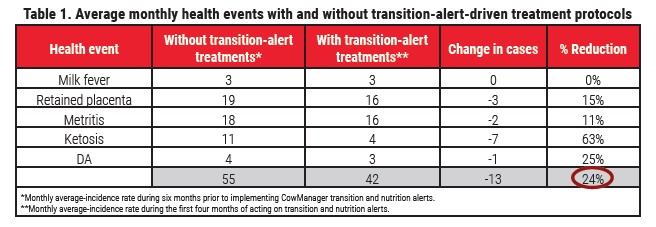
The impact becomes even more meaningful when the results are projected across an entire year. For this dairy, the reduction equates to approximately 156 fewer health events annually, a 3.9% decrease. Fewer sick cows mean less time spent treating animals and fewer disruptions to production and reproduction This ultimately adds real dollars to the dairy’s bottom line.
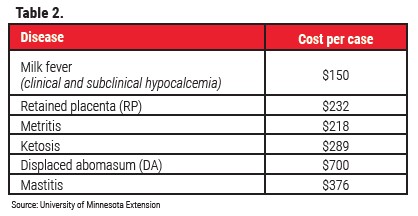
Using industry estimates for the cost of common transition disorders (Table 2), the reduction in ketosis, retained placenta, metritis, and other health events represent thousands of dollars in potential annual savings. Beyond direct treatment costs, healthier cows are more likely to maintain milk production, breed back efficiently, and remain productive in the herd longer, creating additional value that extends well beyond the fresh period.
During the treatment-protocol trial, what really stood out to me wasn’t how the technology performed, but how the dairy used the information and implemented a near labor-free plan, leading to healthier cows. By combining CowManager’s behavioral data with a simple, repeatable protocol, they were able to take action earlier and improve fresh-cow outcomes, without adding an additional lockup.
With four months under their belt, the dairy is invested in continuing to use CowManager’s Transition Monitor, and I’m excited to see what long-term improvements emerge.
Author: Area Sales Manager and CowManager Specialist Sawyer Johnson